Posts

The Pure and the Impure Mind :

Image
1. The Sanskrit term for mind is Manas. Manas is said to be of two kinds, the pure and the impure. That which is associated with the thought of desire is the impure, while that which is without desire is the pure. The pure mind is otherwise known by the name higher mind. The impure mind is called lower mind. To men their mind alone is the cause of bondage or emancipation. That mind which is attracted by objects of sense tends to bondage, while that which is not attracted tends to emancipation. There is said to be salvation for a mind without a desire for sensual objects. An aspirant after emancipation should therefore render his mind ever free from all longing after material objects. 2. The impure mind or Ashuddha Manas is filled with impure Vasanas (tendencies in the mind), Rajas and Tamas and the pure mind or Shuddha Manas is filled with pure Vasanas and Sattva. The impure Vasanas generate rebirths. The pure mind with pure Vasanas leads to Moksha or liberation from births and ...

QUALITIES OF A GOOD STUDENT :

Image
Today’s students are tomorrow’s leaders of a country and the qualities of the student clearly determine the students’ bright future and carrier path. So, who is a good student? What are the qualities of a good student? Historically, the term ‘student’ referred anyone who learns something. However, the recent definition of a “student” is anyone who attends school, college, or university. Again, what are the good qualities of a student? Based on my personal experience and research, I list down the qualities of a good student. (1) Attitude: Basically, a good student possesses the ability and willingness to learn new subjects even the subjects are not interesting. (2) Academic skills: Acquiring academic skills is the most important quality of a good student. Ability to read comprehensively, to write effectively, to speak fluently, and to communicate clearly are the key areas in which a good student must be proficient. Having a good handle in all these areas will make a studen...

Swami's bridge with West :

Image
(From left) Swami Bhajanananda, Swami Atmarupananda, Michael Pelletier, deputy chief of mission at the US embassy in Delhi, and US consul-general Craig Hall at American Center on Thursday. Picture by Sanat Kr. Sinha Swami Vivekananda's bridge with the West, particularly the US, comprised four lanes - intellectual, emotional, social and spiritual, Swami Bhajanananda said at American Center on Thursday. Vivekananda's address to the World's Parliament of Religions in Chicago, in 1893, was a recognition of the plurality of religion that Ramakrishna Math and Mission embodies, Bhajanananda, the assistant secretary of Ramakrishna Math and Mission, said. "Sri Ramakrishna had arrived at three conclusions about religion. There are as many paths as faiths, service to mankind is service to God and the essence of religion is direct transcendental experience of the ultimate reality," the monk said in his speech, the first by a senior functionary of the Math and ...

‘Plain Living and High Thinking’ :

Image
Our forefathers would be considerably amused at many of the maladies that afflict humanity today, e.g., inflation, black-marketing, bootlegging, gun-running, ethoe genus omne. These Frankenstein monsters, threatening to destroy us before long, are our creation as they are merely the inescapable effects of our lapse from a spiritual outlook upon life and the adoption of a purely materialistic philosophy of living. These and myriads of other similar problems have their origin in a love of luxurious living and are the products of a foolish mania on the part of every nation to raise its so-called standard of living over that of its neighbours. The economic blockades, the armament races and the atom-bomb imbroglios are the resultants of human vanity, greed, jealousy, mutual suspicion and hatred; and as each nation wants to be on the safe side by multiplying its power of destruction, there is a regular scramble and competition for becoming the most ruthless and the most destructive p...

Swami Sivananda

Image
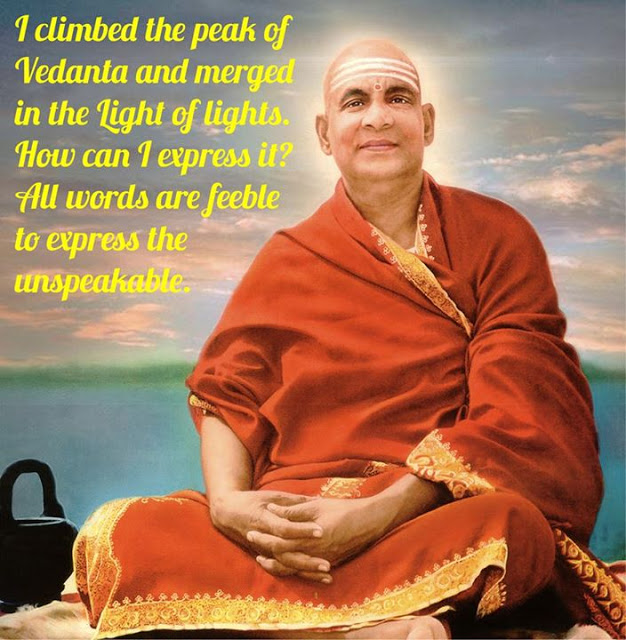
“If India in bondage needed a Gandhi to lead her to freedom, resurgent India needs a Sivananda to make her conscious of her prestigious heritage and resume her spiritual mission”  Swami Sivananda (1887–1963), born in Tamil Nadu came from a family of philosophers and saints, thus deep-rooting a spiritual inclination at a very young age. After completing his degree in Medicine and working as a doctor in India, he went to Malaysia to help cure thousands of Indian workers contaminated with diseases through difficult living conditions. Derived from his great passion for humanity, he would treat the poor for free and also send them home with enough money to make up for their lost earnings while they were sick.  For Sivanandaji, truth, love and purity was the basis of all real religion. After seeing so much suffering, he realised the world is full of pain and that true happiness would not be gathered by wealth. It became his innermost desire to follow the path of the sages ...

The Experience of Detachment From the World of Manifestation :

Image
  Sri Aurobindo’s integral Yoga embraces the world manifestation as the expression of the Divine. This does not, however, imply that the normal human standpoint, centered around the ego-consciousness, is to remain in place without modification. Sri Aurobindo recognizes that the transition to the divine standpoint, and the corresponding change in relation this implies to the forms, beings and forces in the world, requires a total change of consciousness. This change of consciousness comes about through the withdrawal from attachment to the ego and its characteristic way of viewing things. Thus, the undertaking of the traditional Yoga of knowledge, to separate oneself from this ego-consciousness, is a good preliminary step for achieving the eventual goal, which allows the seeker to first abandon the world, and then embrace it again once the new status has been gained. “The experience which we first arrive at by the sort of shortcut to liberation which we have described as the...

Vyasa – The Versatile Genius

Image
           The goal of life as declared by the discoverers of Truth was handed down from Guru to disciple in the distant days of known human history, and along the avenue of time the teaching descended from generation to generation. The torch-bearers of knowledge maintained the relay efficiently up to the time of Veda Vyasa, the poet-seer. Then, Vyasa’s acute intelligence detected a growing danger: a possible threat to the continuation of that sacred relay race.            Hinduism was then facing the danger of total annihilation. The Scriptures were fast fading away even among those who were supposed to be the custodians of the sacred lore. The mantras if the Vedas were being slowly forgotten by the people; in that general forgetfulness of the generation the entire subjective science of the Vedas would have been lost – had it not been for the great revolutionary reformer, the poet philosopher known as Vyasa. ...